


Something has shifted in the way people buy beauty. Shoppers, for a long time, have turned over bottles to read the ingredients, and now they are increasingly looking for something else: where the product was made.
For years, the country of origin was treated as an operational detail for brands, a line on a spec sheet for procurement to worry about. That era is ending. Provenance now shapes how consumers judge a brand, how retailers range it, and how buyers value it. For British beauty, this is an advantage hiding in plain sight.
An industry that pulls its weight
British beauty is worth £28.3 billion to the UK economy. That’s the headline figure from the British Beauty Council’s latest Value of Beauty report, compiled by Oxford Economics. The industry is also responsible for more than 595,000 jobs (a workforce not far off the size of construction), pays £8.8 billion into the Treasury and delivers £4.2 billion of exports shipped around the world.
Whilst the industry is largely recognised for exciting launches, cult movements, and dominating social feeds, the ‘glamorous’ side of things is only half the story. The other half happens early, in labs, filling halls, and loading bays, long before a product gets anywhere near a counter. Much of beauty’s real value is created in places the public never sees, by people whose names never appear on the packaging.
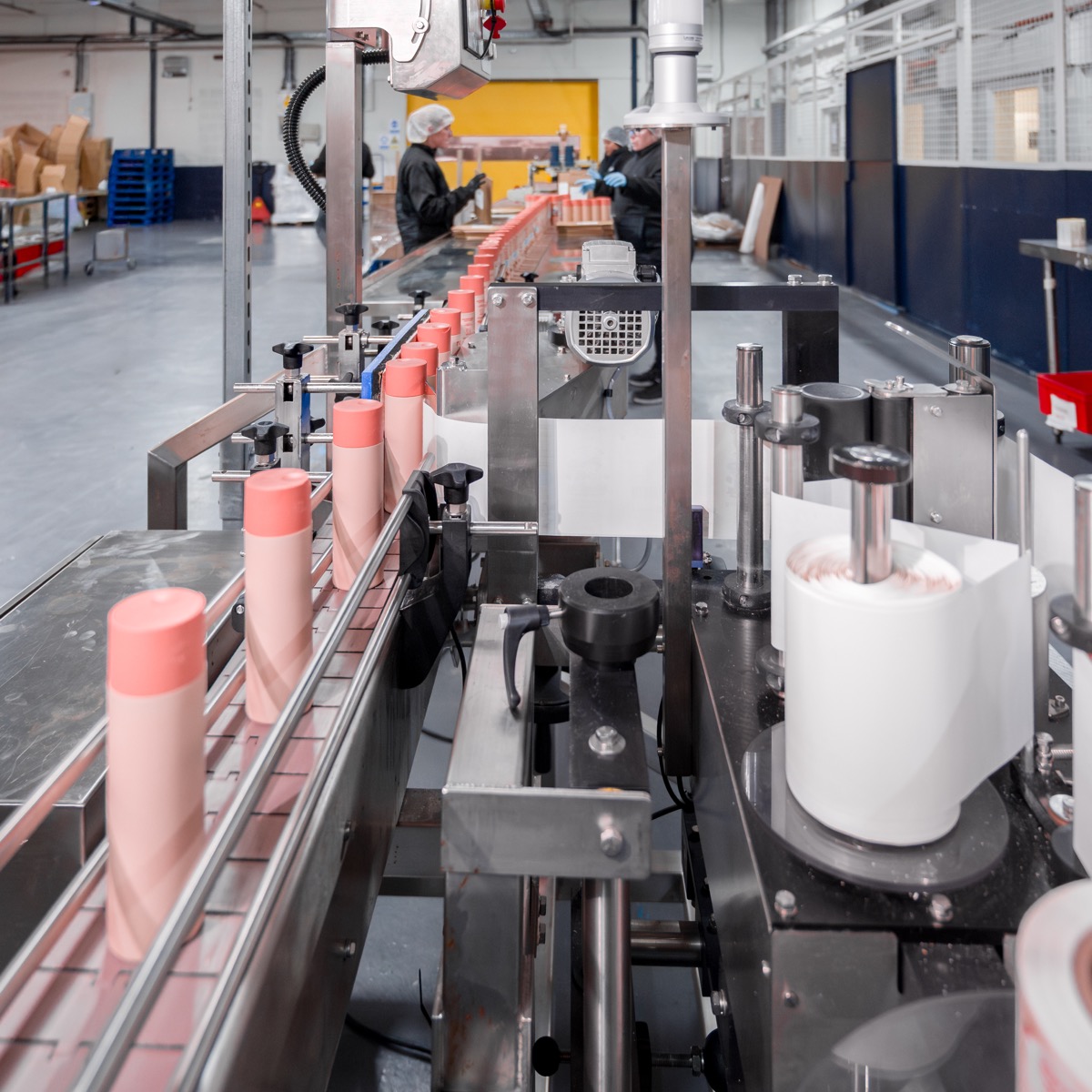
None of it happens without manufacturing. Every brand that scales, every shelf that stays stocked, every pallet bound for an export market started life in a factory. And when that factory is in Britain, the value stays here too. It goes into UK jobs, wages, and training. It reaches packaging suppliers, packaging firms, contract manufacturers, hauliers; one production run can support a whole web of British businesses before a product has even arrived on shelf.
That’s what Made in Britain means, underneath the label. Real jobs, sustained every time a brand chooses to make it here.
Proximity matters
One of the most underrated strengths of British manufacturing is proximity, because proximity changes the nature of the relationship between a brand and its manufacturer.
When the factory is a train ride away rather than a thirteen-hour flight, founders visit, buyers visit, brand managers visit. They stand on the filling line and watch their product come to life, they speak with the Development Chemists creating the product, they can be part of the process in the lab, conversations happen face to face and in the same time zone. Problems get solved side by side, and trust builds at the speed of conversation rather than the speed of sea freight.
The foundation of a strong relationship is partnership over transaction; the strongest British brands are not simply buying capacity from their manufacturers, they are building shared knowledge with them, run after run, year after year, until the manufacturer understands the product almost as well as the founder does. The wider ecosystem reinforces it: the British Beauty Council (of which we are a proud patron) alongside the trade bodies and founder networks working to put British brands on the world stage.
More brands are reaching the same conclusion. A Make UK survey found that 40% of manufacturers had reshored suppliers in the past year, with a similar number planning to follow, and the results are visible in the market. Several of the most celebrated British beauty exits of recent years were built on UK and European manufacturing, with supply chains that held up under a buyer’s scrutiny.
What the consumer sees
Research from Barclays in 2025 found that 71% of UK consumers want to support British businesses by buying more products that are Made in Britain, while two in five are actively looking for UK-made alternatives to the imported products they currently buy. Against a backdrop of tariffs, shipping disruption and rising import costs, buying British has stopped being a sentiment and started becoming a strategy, for shoppers as much as for brands.
The label works because it answers questions before they are asked; Is this made to a standard I can trust? Are the people who made it treated fairly? Do the claims on the front of the pack survive contact with reality?
When manufacturing happens in the UK, those answers can be checked. Certifications like B Corp, ISO, Sedex, and COSMOS are audited realities rather than marketing language, and they carry through to the finished product in a way a consumer can believe. With ‘greenwashing’ and safety claims under closer regulatory and public scrutiny than ever, a supply chain a brand can point to is worth far more than a supply chain it has to explain or justify.
Beneath all of it sits a simpler truth, people like buying products made near them, by companies that invest in the places where they operate. ‘Made in Britain’ is a mark of trust, that can be printed on the back of a bottle.
The cost question
Every conversation about UK manufacturing arrives at the same place eventually… Surely it is cheaper to make it abroad?
For years the honest answer was yes, and in many cases would be today if the only line that mattered was unit price. But unit price was never the full cost, and in 2026 the distance between the unit quote and the true cost has never been wider. Freight rates that swing violently from one quarter to the next. Sixteen-week lead times in a market where demand moves in hours. Growth capital locked up in deposits and stock on the water. Compliance bills that land in the UK regardless of where the bottle was filled. When you evaluate the total landed cost, particularly at the volumes a scaling brand orders, the numbers tell a very interesting story.
We have published a report that does exactly those sums:
Read the report: The true cost of “Made in China” is sitting on your balance sheet →
Making things in Britain was once framed as the sentimental choice, but in 2026 and beyond, it is simply the commercial one, and the feel-good part comes free.